






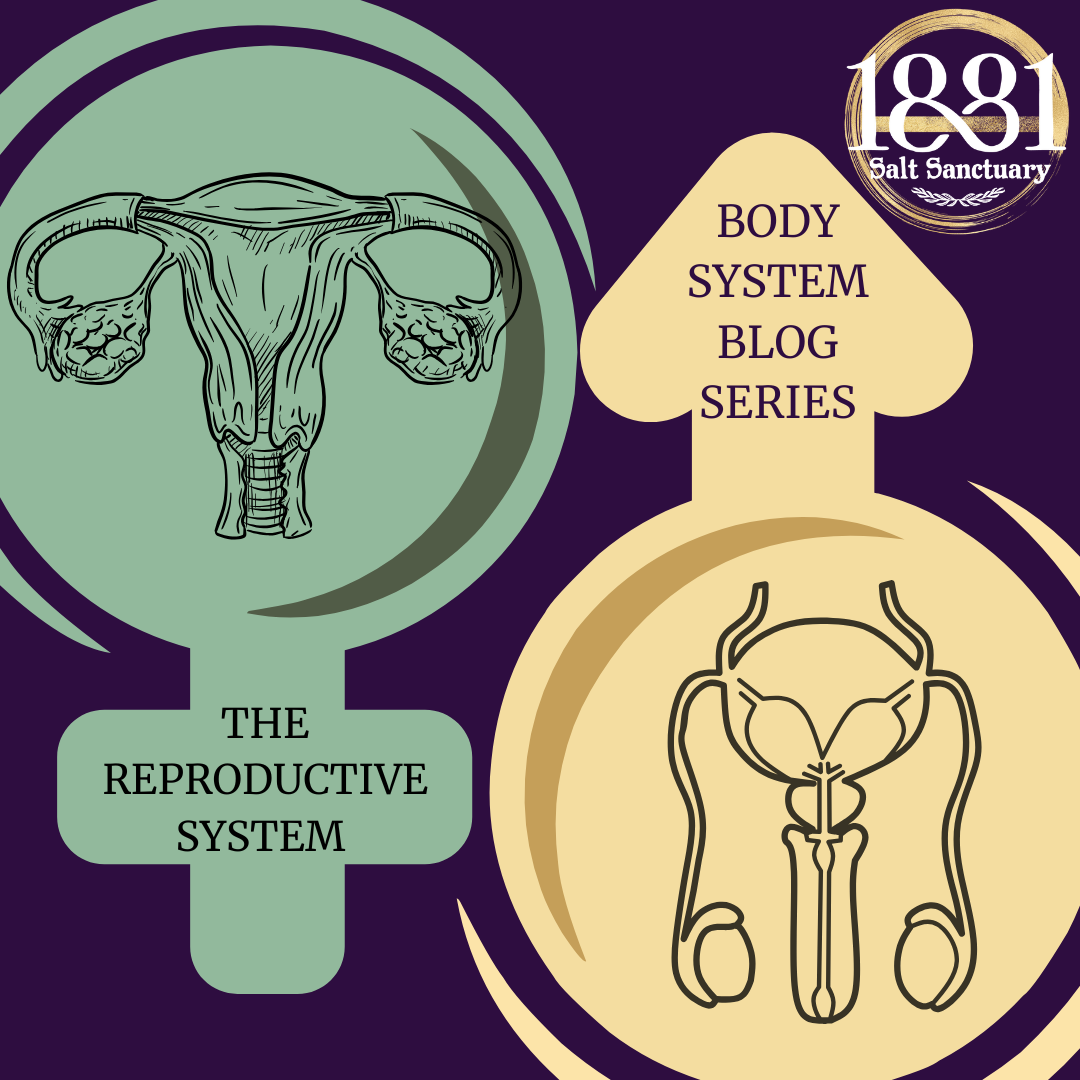
March is not only Women’s History Month but also ushers in the springtime. With green shoots already starting to emerge from the ground, the Earth is eager to begin another cycle of awakening life. In fact, the Spring Equinox even introduces the season of the distinctly uterine-shaped and Mars-ruled Aries, nodding to creative potency across the gender spectrum. So, it’s a great time to talk about the reproductive system!
This system’s biological functions are pretty straightforward–make babies. However, we all know that whether or not we’re using them for that purpose, our reproductive systems frequently affect our day-to-day lives. From pleasure to pain to our very sense of identity, this little group of glands and organs make a big impact. Read on for some holistic approaches to supporting yours through all phases of life.
Reproductive System
Female
The female reproductive system is located in the pelvis. Ovaries produce eggs, or ova, and sex hormones like estrogen, progesterone, and testosterone. They connect to the fallopian tubes, which carry an egg (or more) down to the uterus each month. The uterus, which looks like an upside-down pear, is a muscular organ. It contains the endometrial lining, which is shed each month during menstruation. If an egg is fertilized by sperm, it implants in the lining and begins pregnancy, during which the uterus expands to contain a baby (or more). In such cases, the endometrial lining usually doesn’t shed much till after the pregnancy ends. The cervix, a hard muscular cylinder, acts as a physical barrier between the uterus and the vaginal opening. It softens and dilates during vaginal childbirth to allow babies to pass through the birth canal. The vagina is that canal and is often where people put things like menstrual cups, tampons, penises, fingers, etc. It is sometimes partially or sometimes completely covered by a layer of tissue called the hymen. The hymen can stretch, and the hymen can break. This happens in a lot of ways and means absolutely nothing about a person’s virginity. Virginity is a fairly subjective social construct generally used to control women’s sexuality. The external female genitalia is known as the vulva, and every single one is unique. It consists of the labia majora and labia minora which are folds of skin that protect the area. The inner folds (minora) are thinner and defend against dryness and infection. The outer folds (majora) are thicker and serve as an external barrier. Some are big. Some are small. Some stick out. Some do not. At the very top of the vulva is the clitoris, which is an organ full of nerve endings. Like a penis, it swells with blood during arousal and is one of the main sources of female orgasm. It’s protected by skin called the clitoral hood. Some are big. Some are small. Some are too sensitive to touch directly. Below the clitoris and above the vagina sits the urethral opening, or the hole from which women pee. The “front” of everything is the mons pubis where varying amounts, colors, and textures of pubic hair grow. Two lesser known aspects of the female reproductive system are the vestibular glands in the labia minora, which are active in lubricating the vagina and female ejaculation. If you’re a cis woman and you’ve never looked at one, checking out your own vulva with a mirror can be enlightening. If you’re anyone else of any body type, gender expression, or sexual persuasion, it’s a good idea to view a diagram sometime, if for no other reason than to better understand where we come from.
Male
The male reproductive system shares many similarities with the female reproductive system. In fact, all embryos begin female. Those with Y chromosomes develop into males. Just as the ovaries are responsible for producing eggs, the testicles produce sperm. Just as the highly sensitive clitoris swells during arousal, so does the penis. Unlike female genitalia, these are external organs. The penis is a long shaft through which men urinate and ejaculate. Some have foreskin. Some are circumcised. Some are big. Some are small. Some may struggle to become or stay aroused. Some may orgasm quickly. Nothing is out of the ordinary because no two look or operate the same. The testicles are situated behind the penis and are similarly variable in size and appearance. They are held in a sack called the scrotum which can retract closer to the body to keep warm or extend away from it to cool off. This allows the body to maintain the ideal temperatures for sperm production. Sperm develop further in the epididymis and travel through the vas deferens into the abdominal cavity. There, it mixes with fluids from the prostate gland, seminal vesicles, and bulbourethral gland before exiting the urethra during ejaculation.
Intersex
Intersex covers a broad range of bodies that don’t fit neatly into male or female categories. Sometimes these differences are apparent at birth, and sometimes they are discovered during or after puberty. Some intersex people identify with one gender or another, while some are comfortable outside of that binary. Some receive treatment to mitigate the effects of their condition, and some do not. Some are able to become biological parents, and some are not. It is not a disease. While intersex people can be transgender or nonbinary, they are not the same topic. Just as no two people are alike, no two bodies are alike. If you are intersex, you’ll have your own set of needs and experiences. If you know someone who is intersex, don’t make assumptions about those needs or experiences.
Reproductive Life Phases
Childhood
While people generally identify a child’s sex at birth based on their visible genitalia, primary sex characteristics, the reproductive system doesn’t develop fully for several years. Though it’s good to note that hormonal shifts happen earlier than previously thought. Long before visible signs of puberty appear, children may be energetically and temperamentally affected by changes in their endocrine system. This can occur as early as age eight for some.
Puberty
During puberty, children begin to develop what are known as secondary sex characteristics. This includes the appearance of pubic hair for both sexes, breasts for girls, and facial hair for boys. Voices change. Skin breaks out. Moods swing. People become interested in sexual activity. It’s an intense time. It’s also when girls begin to experience the menstrual cycle. During this cycle, the body prepares for potential pregnancy by building up the endometrial lining, ovulating (releasing an egg) and ultimately shedding the endometrial lining if no pregnancy occurs. During this time, different hormones rise and fall. This cycle takes approximately four weeks, though that can vary person to person. Some girls experience extreme mood swings. Some don’t. Some experience acne. Some don’t. Some experience severe pain. Some don’t. Some experience more serious illnesses related to this cycle like premenstrual dysphoric disorder or endometriosis. If you or your daughter are suffering from symptoms that are disruptive to your life, it’s worth speaking to a healing professional to see what can be done to assist you. Boys and men are also subject to hormonal cycles, though these rise and fall in the span of a single day.
Adulthood and Pregnancy
Theoretically, adulthood is a time during which people have gotten the hang of their bodies after the big changes of puberty. For most women, the period of time during which they may become pregnant covers a few decades from puberty on. To avoid this, people use various forms of protection like condoms, the pill, IUDs, vasectomies, and the rhythm method. Condoms are the only ones that protect against sexually transmitted infections, or STIs. Pregnancy occurs when an egg fertilized by a sperm implants into the uterus. Sometimes this happens through vaginal sex. Sometimes it happens through IVF. Sometimes it happens through IUI. Sometimes it never happens. Sometimes it happens to someone else. Oftentimes, women experience pregnancy loss. This is completely normal but incredibly hard. Sometimes women receive abortions. This is completely normal but can also be incredibly hard. Sometimes they are performed out of medical necessity. Sometimes they are not. In an ideal world, they are performed by doctors and nurse practitioners whose judgment and experience are trustworthy. When a pregnancy is successful, a series of massive hormonal shifts occurs over a period of about ten months. During that time, the uterus expands while a baby (or more) develops. A placenta, which is an organ that supplies nutrients to the baby through the mother’s blood, also develops. Several other things happen, but that is the length and subject of many books. When a baby is born, the amniotic sac in which it floats ruptures, the cervix dilates, and the uterus contracts. This allows for a vaginal birth. Sometimes women have c-sections instead. Sometimes they’re planned. Sometimes they’re emergencies. Birth and the postpartum period can be very dangerous and have historically been a major mortality risk for women. Today, when proper medical care is available, the risks are lower than ever before. Women may have several babies during their adulthood, or they may have none. Some love children. Some do not. When women are not pregnant, most continue to experience the menstrual cycle that began in puberty. Throughout adulthood, women should do self-screening for breast cancer by checking for lumps and receive routine gynecological exams to screen for cervical cancer. Men should conduct self-screening for testicular cancer by checking for lumps. Both men and women who are sexually active should receive routine screenings for sexually transmitted infections.
Menopause and Andropause
Menopause occurs when the body’s production of female sex hormones downshifts drastically and the menstrual cycle ends. This process takes a while, often several years. For many, it comes along with mood swings, hot flashes, reduced sex drive, body pain, weight changes, and even cognitive symptoms. It usually happens between a woman’s mid-40’s and mid-50’s, though this can vary. These changes impact other areas of health like bone density and heart health. While men’s experiences may seem less apparent, they do experience a reduction of testosterone over time. This impacts sex drive, energy, mood, body composition, prostate health, and other physical factors. Prostate exams are essential for early detection of cancer. Unlike women, andropause does not necessarily preclude men from reproducing. Men should continue taking proper precautions when having sex with women of childbearing age.
Caring for your reproductive system
In Practice
Knowing is half the battle. In a society where shame around sexuality abounds, it can be easy to dismiss and avoid our reproductive systems. Bodies are often objectified while sexual experiences are compartmentalized. We can become deeply out of touch with this vital area of health. Making a concerted effort to stay in touch – literally – can help you to better assess your sexual health. From the look and feel of your unique anatomy to the ebb and flow of your hormones, knowing your baseline is essential to catching when something is off. Make a commitment to become an observer of your body.
Once you know your body, you can better understand if and how you want to use it and with whom. Joyful and consensual sexual expression is healthy. In fact, endorphins from sex can help you relax, reduce stress, and assist with depression and anxiety. Sex improves mood, aids sleep, promotes heart health, and even is thought to boost the immune system. For men, regular ejaculation reduces the risk of prostate cancer.
Sexual intimacy is also great for relationships, with ourselves and others. Not only can sex boost our own sense of self confidence, but it can strengthen the bond between partners. And of course, sex used for reproduction creates an entirely new parent-child bond.
Energetically, the reproductive system corresponds to the sacral chakra. The sacral chakra, of course, fosters our sense of creativity. It’s also a space of strong emotion, demanding flow and connection. Expressive activities like painting or spending hours in pleasing conversation can support this chakra and the reproductive system. Releasing shame can be the goal of sacral chakra work or a pleasant byproduct of it. Either way, working toward connection and expression are wonderful ways to support the reproductive system.
Diet
Men and women need very different things at different times of their lives. There’s no one-size-fits-all approach to eating for reproductive health. For men and women trying to become pregnant or in the process of pregnancy, eliminating alcohol is a great start. Women should take folic acid and would likely benefit from prenatal vitamins. Adult women need far more iron than men due to their menstrual cycle. In fact, the recommended daily intake for women is 18mg, while for men it’s only 8mg.
In general, our reproductive systems need a strong mix of healthy fats, protein, and other nutrients. These are essential for fertility. Cruciferous vegetables can prove to be essential in preventing cervical cancer, while antioxidants from fruits and berries promote reproductive health.
Aphrodisiacs are go-to snacks for sex drive. Chocolate, oysters, strawberries, and honey are just a few of the popular favorites. These often work by activating physiological responses like increasing blood flow or invoking our cultural and psychological connections to food.
Exercise
Beyond doing the deed itself, there are a ton of exercises that can benefit reproductive health. Kegels, during which one contracts the pelvic floor, help to strengthen these muscles and even make orgasms more powerful. They also help with incontinence and the structural weaknesses that can occur after childbirth.
Bridge pose is another great way to work out this area of the body. Lay on the floor with your knees bent and your feet pulled in close to your glutes. Gently lift your shoulders and shimmy your arms underneath your back. If it’s comfortable, you can bring your palms together, or you can rest them flat on the floor. Inhale and lift your hips toward the sky, leaving your shoulders and feet rooted to the ground. Focus on pushing up with your glutes rather than letting your pelvis sag toward the floor. You can hold this position or try shorter pulses.
Anything to strengthen the abdomen or increase blood flow throughout the body will benefit your sexual and reproductive health. Not to mention that the endorphins and confidence boost we get from exercise can help us get into the mood more easily.
Supportive Herbs and Supplements
Our bodies have different needs during each of the different phases of life and even during different phases of the month. Here’s a short list of some of the herbs we recommend for different reproductive health issues:
For Men:
- Saw palmetto and stinging nettle are both good for prostate health. They do this by reducing inflammation and possibly blocking hormones that lead to prostate cancer.
- As men age and estrogen increases, their ability to effectively use zinc from their diet decreases. Supplementing it can help with that and improve prostate health.
- Gingko biloba increases blood flow and can act as a natural assist for erectile dysfunction.
- Fenugreek and maca are known for improving testosterone levels.
For Women:
- Boric acid is a popular treatment for yeast infections and bacterial vaginosis, common uncomfortable conditions in the vagina. This should be used as a suppository and not taken orally.
- Turkey tail is known for its benefits to breast health, the immune system, and even bone health.
- Ginger and red raspberry are great options to assist with menstrual cramps.
- Black cohosh and red clover are popular choices for combatting hot flashes and other menopausal symptoms.
For Both:
- Cranberries and cranberry extract are excellent resources for urinary health.
- Chamomile and ashwagandha are stress relievers that help men and women to relax, which can lead to major improvements in sex drive and enjoyment.
These are just the tip of the iceberg. For more specific advice catered to your unique experience, visit our apothecary!
Leave a Reply